
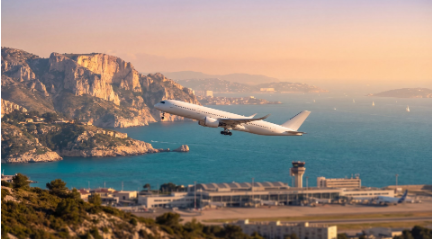
Marseille Provence airport has grown steadily over the past decade, adding low-cost routes, seasonal charters and more connections to North Africa and the rest of Europe. That growth comes with a downside: a single busy runway, summer heat waves, and occasional wildfire smoke near the airport in July 2025 forced a temporary closure that pushed average departure delays past two and a half hours. Anyone flying through Marseille should know what happens once a delay is announced, and what they are entitled to when it drags on.
European rules cover most flights through Marseille
Because Marseille Provence is an airport within the European Union, EU Regulation 261/2004 applies to every flight departing from it, regardless of which airline operates it or where the passenger is travelling to. It also applies to inbound flights landing in Marseille when the airline is based in the EU. The regulation was written specifically to stop airlines treating long delays as a routine inconvenience with no consequence, and it sets out fixed obligations rather than vague promises of goodwill.
How long a delay has to run before compensation applies
A short delay of an hour or so rarely triggers anything beyond an apology at the gate. The threshold that matters is three hours: once a flight lands three hours or more after its scheduled arrival time, the airline owes financial compensation under the same scale that applies to cancellations, unless it can prove the delay was caused by something outside its control. Passengers waiting at Marseille Provence should note the scheduled arrival time on their boarding pass and track the actual landing time, since that gap is what determines eligibility.
Compensation amounts by flight distance
The amount owed depends on how far the flight travels, not on the ticket price. Flights of 1,500 kilometres or less, which covers most routes to the rest of France and southern Europe, carry a compensation of €250. Flights between 1,500 and 3,500 kilometres, including most connections across the EU, carry €400. Longer flights outside Europe, such as routes to North Africa’s more distant cities or transatlantic connections, carry €600. These figures are set out in the regulation itself and are not negotiable on a case-by-case basis.
When airlines are exempt from paying
Airlines do not owe compensation when a delay results from what the regulation calls extraordinary circumstances: severe weather, air traffic control restrictions, security threats, or a runway closure like the one caused by nearby wildfires in July 2025. A mechanical fault, however, is treated differently. Courts have repeatedly ruled that routine technical problems count as part of normal airline operations and do not excuse the airline from paying, since maintenance issues are considered foreseeable and within the airline’s control.
What counts as an extraordinary circumstance in practice
The line between an extraordinary circumstance and a normal operational problem is not always obvious from the gate, which is why so many disputes end up being decided later rather than on the spot. A closed runway due to smoke, as happened in July 2025, clearly falls outside the airline’s control. So does a lightning strike, a bird strike, or a security alert. A missing crew member, a late-arriving aircraft used earlier that day for another route, or a routine part replacement do not usually qualify, even though they can feel just as unavoidable to the passenger stuck waiting. If staff cite generic ‘operational reasons’ without further detail, it is worth asking exactly what happened and noting the answer.
Practical steps to take at the gate
Ask a member of staff to confirm the reason for the delay in writing, or at least note what is announced over the tannoy and the time it happens. Keep your boarding pass and any app notifications showing the original and revised times. Once a delay passes the three-hour mark, the airline is required to offer meals and refreshments proportionate to the wait, and a hotel if the delay runs overnight. Passengers who want to pursue delayed flight compensation afterwards will need exactly this kind of documentation, so it is worth gathering it at the airport rather than trying to reconstruct events weeks later.
Before your next trip through Marseille
Delays at a regional airport like Marseille Provence are rarely announced with much warning, so the best preparation is knowing your rights before you travel rather than looking them up mid-delay. Note the three-hour threshold, keep every piece of paper or screenshot the airline gives you, and remember that a claim can usually still be filed well after the trip is over. A frustrating afternoon in the terminal does not have to end without any recourse at all.

Rédacteur passionné de Marseille, de voyage et évidemment de l'OM 🙂
- Romain Lonie
- Romain Lonie
- Romain Lonie
- Romain Lonie
- Romain Lonie
- Romain Lonie
- Romain Lonie
- Romain Lonie
- Romain Lonie
- Romain Lonie
- Romain Lonie
- Romain Lonie
- Romain Lonie
- Romain Lonie
- Romain Lonie
- Romain Lonie
- Romain Lonie
- Romain Lonie
- Romain Lonie
- Romain Lonie
- Romain Lonie
- Romain Lonie
- Romain Lonie
- Romain Lonie
- Romain Lonie
- Romain Lonie
- Romain Lonie
- Romain Lonie
- Romain Lonie
- Romain Lonie
- Romain Lonie
- Romain Lonie
- Romain Lonie
- Romain Lonie
- Romain Lonie
- Romain Lonie
- Romain Lonie
Nos images sont à but illustratif et peuvent ne pas représenter la réalité